France eSIM for Digital Nomads: Working Remotely with a French Number
If you have spent any time trying to work remotely from France, you already know the problem. The café Wi-Fi cuts out mid-Zoom call. The coworking space charges a daily rate just to get a reliable connection. And every time you need an SMS verification code for your banking app or Slack login, you are sitting there hoping your home number still works from 1,500 kilometres away. A france esim with number changes all of that in a single scan.
The digital nomad population has grown significantly over the past few years, and France has become one of the most popular long-term bases in Europe. Paris, Lyon, Bordeaux, and the south coast all attract remote workers who want a real quality of life alongside a functional work setup. But living and working in France requires more than good coffee and fast trains. It requires a phone number that actually works like a local one.
This guide covers what you need to know about getting a French eSIM with a real number, why data allowances matter for remote work, how 2FA and client-facing work depend on a stable local line, and why hotspot capability is non-negotiable when you are running a laptop from a terrace in Montpellier.
TL;DR
A France eSIM with a real French phone number solves the biggest pain points for digital nomads: SMS-based two-factor authentication for remote work tools, client calls from a local number, and high-data hotspot use for laptop working. Plans of 60GB and above give you the headroom to work full days without rationing. You do not need a French address or contract. You install it on your phone before you land and it works the moment you arrive.
Why France is a Growing Base for Remote Workers
France sits in a uniquely convenient position for location-independent workers. The time zone overlap with London, Berlin, and most of Western Europe is seamless. Transport connections are exceptional. The cost of living outside Paris is genuinely manageable compared to cities like Amsterdam or Zurich. And the quality of mobile infrastructure is among the strongest in Europe, with Orange, Bouygues, and SFR all running extensive 4G and 5G networks that reach well beyond the major cities.
For nomads spending weeks or months in one place rather than passing through, that infrastructure matters. A tourist eSIM that gives you 5GB for a week is not built for someone running video calls, uploading files, and staying connected across multiple devices. The remote work use case is fundamentally different, and the phone number question sits at the centre of it.
The Local Number Problem and Why It Matters for Work
Most travel eSIMs are data-only. They give you mobile internet, which is useful, but they do not give you a French number. For tourists, that is often fine. For remote workers, it creates real friction almost immediately.
Here is where that friction shows up in practice. You go to register with a French coworking space and they ask for a local contact number. You try to book accommodation for a longer stay and the landlord or agent wants to call a French number, not an international one. A French client asks for a phone number to add to their contact list and your foreign number creates hesitation you did not need. These are small things individually, but they accumulate quickly when you are trying to work and live in the same place.
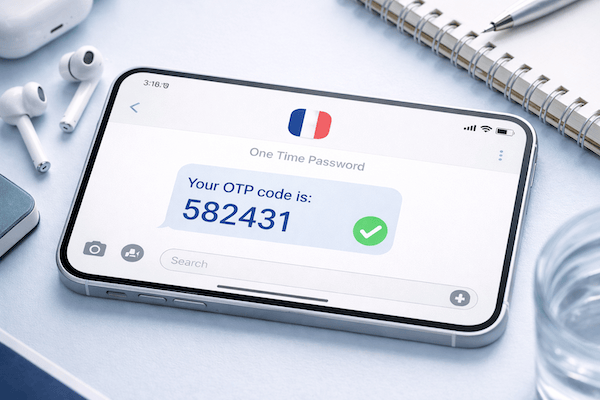
The bigger issue, though, is authentication. SMS-based two-factor authentication is embedded across almost every professional tool a remote worker uses. Slack sends login codes via SMS when you access from a new device. Banking apps, payment platforms, invoicing software, VPN portals, and Google Workspace admin accounts all use phone verification at some point. If your registered number is in another country and you are roaming, those codes can be slow, unreliable, or blocked altogether depending on how the SMS routing works.
A stable French number tied to your eSIM means those codes arrive instantly because they are going to a local line on a local network. That reliability is not a luxury for remote workers. It is the difference between logging in and getting locked out.
2FA, Slack, and the Hidden Complexity of Working Across Borders
Two-factor authentication has become a standard security layer across corporate tools, freelance platforms, and financial services. When you travel, especially for extended periods, the SMS-based version of 2FA becomes one of the most frustrating parts of your setup. Your home number may not reliably receive international SMS, particularly from platforms that route verification codes through providers with uneven global coverage.
Slack, for example, requires phone verification when you log in from a new device or location. If your team uses Slack for daily communication and you suddenly cannot receive that verification code, you are effectively cut off from your primary work channel until you find an alternative. Similarly, many freelance platforms including payment processors and contract management tools use SMS as a fallback verification step, especially if you are accessing from an unfamiliar IP address or geographic region.
VPN access is another area where this creates complications. Many corporate VPNs send a one-time code to your registered mobile number as part of the authentication flow. If that number is unreachable or slow to receive SMS, you cannot get onto the network. Remote workers who depend on VPN access to client systems or internal tools need that authentication to work cleanly every time, not sometimes.
Getting a france esim with number solves this cleanly. Your French number becomes the authentication number for your France-based tools and accounts. Codes arrive on the same network your data is running on. There is no international routing delay and no dependence on your home carrier forwarding SMS internationally.
Hotspot Use: The Underrated Requirement for Laptop Workers
Most digital nomads do not work purely on their phone. The phone handles communication, calendar, and quick responses, but the actual work happens on a laptop. That means your phone’s mobile data needs to extend to your computer through a personal hotspot, and that changes the data equation completely.
A typical day of remote work over a hotspot is not light on data. A single hour of video conferencing uses somewhere between 1GB and 2GB depending on resolution settings. Add background sync for cloud storage, file uploads, browser-based tools, and the occasional video asset download, and you can move through 5GB to 10GB in a standard working day without doing anything unusual.
That makes low-data plans essentially useless for laptop workers. A 10GB monthly plan gets used in two working days. This is why the jump to 60GB, 80GB, and 100GB plans exists and why it is the right category for anyone running a laptop from their phone’s connection. Larger data buckets are not about excess. They are about having enough runway to work without constantly monitoring your balance or rationing your connection during a deadline week.
The other thing worth knowing is that not all eSIMs support hotspot tethering. Some data-only plans restrict it or throttle speeds when you share the connection. Any plan designed for remote workers needs to explicitly support tethering without restrictions, and France eSIM plans from specialist providers are built with exactly that in mind.
Client-Facing Work and the Value of a Stable Local Line
If your work involves any direct contact with French clients, partners, or service providers, having a French number is not just a convenience. It is a credibility signal. French businesses, especially smaller ones, are accustomed to calling local numbers. An overseas number, or worse, a call that comes through as unknown, creates an extra step of friction before a conversation even starts.
Freelancers who work with French companies, consultants who service European clients from a French base, and entrepreneurs who are building relationships in France all benefit from the legitimacy that a local number provides. It removes a subtle but real barrier to being taken seriously as a local presence rather than a transient visitor.
Beyond the perception angle, there are practical considerations. French banking services, utility providers, and coworking memberships often require a French contact number for their records. If you are renting an apartment for three months, the landlord or agency will ask for one. If you are setting up a French professional account, you may need to verify it with a French number. A proper eSIM plan that includes a real French number handles all of this without any workarounds.
What to Look for in a France eSIM Plan for Remote Work
Not all France eSIM plans are structured for remote workers. Many are tourist products designed for short stays and light browsing. When you are evaluating options, the following factors actually matter for a working setup.
Data volume is the starting point. For laptop-based remote work with regular video calls and hotspot use, 60GB should be treated as a floor rather than a ceiling. Plans in the 80GB to 100GB range give you room to work normally without micromanaging your data. If a plan includes top-up options without having to cancel and reinstall, that is an additional advantage for longer stays.
A real French number, not just a data connection, is essential for the authentication and client communication reasons covered above. Some eSIM products advertise themselves as including a number but provide a virtual number through a third-party app rather than a genuine SIM-linked French line. The distinction matters for 2FA reliability and for making and receiving standard calls.
Hotspot support needs to be confirmed explicitly, not assumed. Tethering restrictions are buried in the terms of many plans and only become obvious when you try to connect your laptop. Plans designed for remote work explicitly state that mobile hotspot is included and unrestricted.
Network quality in France is generally strong across Orange, Bouygues, and SFR. Any plan running on these networks will give you solid urban coverage and decent rural performance. The difference between providers is less about the underlying network and more about the plan structure, the number feature, and how the service handles long-term use.
How to Set Up Your France eSIM Before You Arrive
One of the practical advantages of eSIM over a physical SIM is that the setup happens before you travel. You purchase the plan online, receive a QR code by email, and scan it from your phone’s settings. The eSIM profile installs to your device and waits until you arrive in France and connect to the local network.
Because you keep your existing physical SIM in place during this process, you do not lose your home number at any point. Most modern smartphones support dual SIM operation, meaning you can run your home number alongside your French eSIM simultaneously. Your home number stays active for whatever you need it for, and your French number handles all local and work-related activity.
For the authentication setup specifically, once you have your French number active, it is worth updating your 2FA settings on key platforms to include it. Slack, banking apps, payment platforms, and any work tools that use SMS verification should be updated so that codes go to your French number while you are based in France. This takes fifteen minutes to do properly and saves significant time later.
France eSIM for Long Stays: Monthly Plans and Renewals
Digital nomads who plan to stay in France for one to three months need a plan structure that matches that timeline, not a tourist plan that expires after a week and requires a new purchase and reinstallation every seven days.
Monthly plans with 60GB or more are the practical choice for this use case. They give you a full month of working headroom, a consistent French number throughout your stay, and the predictability of knowing what your connectivity costs for the month. When it comes to renewal, plans that extend the same number rather than issuing a new one are preferable. Continuity of your French number matters if you have given it to clients, used it for account verification, or registered it with any local services during your stay.
For nomads who move between France and other European countries during their stay, it is worth checking whether your France eSIM includes any EU roaming allowance. Many French mobile plans carry EU roaming rights, which means your French number and data can work across the EU at no extra cost up to certain thresholds. This is genuinely useful if you take a week in Spain or Italy and want to stay on the same plan and number throughout.
Choosing the Right Plan for Your Working Style
The right plan depends on how you work more than how much you travel. If your work is entirely browser and email-based with occasional calls, a 60GB monthly plan covers you comfortably. If you run daily video calls, upload large files regularly, or use your phone as the primary hotspot for multiple devices, you should be looking at 80GB to 100GB plans and treating top-ups as a normal part of your workflow rather than an emergency measure.
The number feature is non-negotiable if any of the following apply to you: you use SMS-based two-factor authentication on tools you access daily, you have French clients or contacts who will call you directly, you are using French banking or financial services during your stay, or you are registering with any local services that require a contact number. That covers the vast majority of remote workers based in France for more than a couple of weeks.
Getting a france esim with number designed specifically for longer stays and working use gives you the infrastructure to operate properly rather than constantly working around the limitations of a tourist data product. The difference in daily experience is significant, and the cost difference between a basic data plan and a full plan with a number is minimal relative to the problems it solves.
Frequently Asked Questions
Can I use a France eSIM for two-factor authentication on work apps like Slack and banking tools?
Yes, and this is one of the strongest reasons to choose an eSIM plan that includes a real French number rather than a data-only plan. SMS-based 2FA codes sent to a local French number arrive reliably on the local network. There is no international routing delay or risk of codes failing to reach a foreign number. When you set up your French number on arrival, update your key apps to use it for verification during your stay.
How much data do I actually need for remote work in France?
If you are working from your phone’s hotspot on a laptop and doing regular video calls, plan for a minimum of 5GB to 10GB per working day. Across a full working month, that puts you well above 60GB under normal conditions. Plans of 60GB to 100GB are the right range for most full-time remote workers. Light users who primarily use their laptop on café Wi-Fi and only use mobile data as a backup could manage with less, but it is better to have headroom than to be rationing data mid-project.
Can I keep my home SIM active while using a France eSIM?
Yes. eSIMs work alongside your physical SIM in dual SIM mode on most modern smartphones. Your home number stays active for calls and messages from people who have it, while your French eSIM handles local calls, SMS verification, and mobile data. The two lines operate independently and you can set which one handles data and which handles calls from your phone’s settings.
Is hotspot tethering included in France eSIM plans for remote workers?
It depends on the plan. Tourist-grade eSIMs sometimes restrict or throttle hotspot use. Plans designed for remote workers and longer stays explicitly support mobile hotspot tethering without speed restrictions. Always confirm this before purchasing, particularly if your laptop connection depends on it. EuropeNumber’s France plans include hotspot support as a standard feature.
Do France eSIM plans include EU roaming for travel within Europe?
Many France eSIM plans from providers operating on French networks include standard EU roaming rights, which allow you to use your French data and number across EU member states at no additional cost, up to a fair use threshold. This is useful for nomads who move between France and neighbouring countries during a longer trip. Check the specific plan terms, as roaming allowances vary between providers and plan types.
How long does it take to set up a France eSIM?
Setup takes around five to ten minutes from purchase to installation. You receive a QR code by email, scan it from your phone’s cellular settings, and the eSIM profile installs automatically. The profile waits until you arrive in France and connect to a supported network, at which point your French number and data activate. It is designed to be done before you travel so that you are connected the moment you land.
What is the difference between a data-only France eSIM and one with a number?
A data-only eSIM gives you mobile internet access in France but no French phone number. You cannot receive calls or SMS on a French number, which means SMS-based 2FA codes do not work reliably and you cannot give French contacts a local number to reach you. An eSIM with a number includes a genuine French mobile number for calls, texts, and SMS verification, alongside your data allowance. For remote workers, the number is as important as the data.