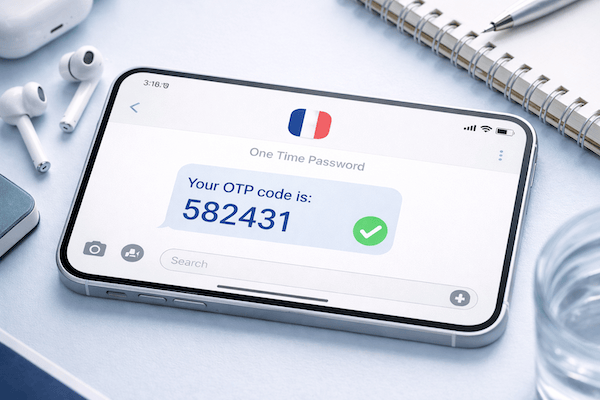
France eSIM for Receiving OTP and Two-Factor Authentication Codes
Picture this: you are sitting in a Paris café, trying to log into your bank account, confirm a booking, or verify your identity on a French government portal. A six-digit code gets sent to your phone. Thirty seconds pass. Nothing. You request it again. The session expires and you are locked out.
This is not an edge case. It catches travellers and expats constantly — anyone who arrives in France with a data-only eSIM or a VoIP number, assuming SMS will behave the same way it does at home. It does not. Understanding why is the difference between a smooth stay and a genuinely frustrating one.
TL;DR
OTP codes and two-factor authentication require a real mobile number on a live cellular network. Data-only eSIMs and VoIP numbers cannot receive these codes reliably from French banks, government portals, or major app services — they fail the carrier lookup checks built into every verification system. A france esim with number that includes a genuine +33 French mobile number is the only product category that solves the problem. The rest of this article explains the technical reasons and practical consequences.
What Is an OTP and Why Does It Need a Real Phone Number
A one-time password (OTP) is a temporary code sent via SMS to confirm your identity during a login or transaction. Two-factor authentication (2FA) works on the same principle: you enter your password, then the service sends a six-digit code to your registered phone number as a second verification layer.
This mechanism underpins most of France’s digital infrastructure. Ameli (health insurance), CAF (social services), France Travail, French banking apps, and hundreds of private platforms all rely on SMS-based OTP. These platforms are built around the assumption that every user has a functioning French mobile number. If yours cannot receive SMS, you cannot get in — there is no fallback and no workaround that works consistently.
The verification systems behind these codes do not blindly dispatch an SMS to whatever number you provide. They run the destination number through carrier lookup tools and fraud-screening databases first. Your number must be registered as an active mobile subscriber on a licensed cellular network. Numbers that fail this check receive nothing — the block happens silently at the aggregator level, before the message ever leaves the system.
Why VoIP Numbers Fail for French OTP Verification
VoIP numbers are internet-based phone numbers assigned by services like Google Voice, Skype, Rebtel, or any virtual number app. They look like mobile numbers but route through the internet rather than a physical SIM on a cellular network.
When a French bank or verification service sends an OTP, its aggregator runs a carrier lookup — sometimes called an HLR (Home Location Register) query — before dispatching the message. If that query returns a VoIP classification, the message is blocked. Banks do not want security codes going to numbers that could be shared across multiple users or that have no verified physical SIM attached to a real identity.
Even if a VoIP provider claims their numbers work for SMS verification, reliability in France is consistently poor. Orange, BNP Paribas, Crédit Agricole, La Poste, and Ameli are among the platforms where VoIP failures are most commonly reported. You might receive a code once by luck. You will not receive them consistently — and with verification codes, inconsistency is effectively the same as failure.
Why Data-Only eSIMs Cannot Help With SMS
This is the mistake most travellers make. They buy a data-only eSIM for France — which provides fast mobile internet on SFR, Bouygues, or Orange — and assume that SMS and calls come with it. They do not.
A data-only eSIM is precisely what it says. It connects to the cellular network to carry internet traffic. There is no SMS channel. There is no voice channel. Even if a number appears in your device settings alongside the eSIM, it is a technical routing identifier — not a genuine mobile number registered for SMS delivery on the French network.
The result: you can browse the web, use apps, and stream video, but when a Fnac checkout asks you to verify a payment, when Chronopost sends a delivery code, or when Ameli requires a verification PIN, nothing arrives. The network signal you can see in your status bar is not the connection that SMS verification requires.
What Makes a Real +33 Mobile Number Different
A genuine French mobile number — one beginning with +33 6 or +33 7 — is registered on the Home Location Register of a licensed French mobile network. When an OTP aggregator runs a carrier lookup on that number, it gets back exactly what it is looking for: an active mobile subscriber on a licensed French network. The message gets sent. The SMS arrives.
This is the technical reason everything else fails where a real French number succeeds. The number is not virtual. It is not assigned to a shared pool. It is a real subscriber on a real network, and the verification infrastructure powering French banking, e-commerce, and government services recognises it as such.
For travellers, expats, remote workers, and anyone managing French accounts from abroad, this is not a minor technical distinction — it is the entire difference between accessing your accounts and being permanently locked out. A france esim with number that meets these criteria is the only product category that solves the problem end to end.
Why This Problem Is Getting More Urgent
France’s move toward digital-first services has accelerated. Government portals that used to accept paper or in-person verification now require online confirmation with an SMS code. Banking regulations have tightened, making 2FA mandatory for most transactions over €30. Booking platforms, insurance providers, and delivery services have all added SMS verification layers in recent years.
The result is that a visitor or remote worker who could previously manage occasional French admin without a local number now encounters verification walls at almost every digital touchpoint. Search data reflects this shift — queries around “France eSIM OTP”, “receive SMS France”, and “france esim with number” have grown steadily as more travellers hit the wall and start looking for solutions before their next trip.
Practical Scenarios Where This Matters
Consider someone relocating to France for a work assignment. In the first week they need to open a French bank account. Every major institution — BNP Paribas, Société Générale, La Banque Postale, Crédit Mutuel — requires SMS verification during account opening and for every subsequent login. Without a French mobile number, the entire financial setup stalls from day one.
Or a short-term visitor trying to rent a car through a French platform, verify their identity for an apartment rental, or access the Parcoursup university portal. Or a freelancer invoicing French clients through a platform that mandates 2FA on every session. Or a tourist whose travel insurance claim requires identity verification via SMS. In every case the requirement is the same: a real +33 number that reliably receives an SMS.
The same friction applies at checkout. French online retailers increasingly require number verification for fraud prevention. International numbers and VoIP numbers fail this check at a growing rate, and once a transaction is declined at that stage there is no simple workaround — you either have a working French number or you do not.
How to Choose the Right France eSIM for OTP
Not all products marketed as France eSIMs include a genuine mobile number. When evaluating options specifically for OTP and SMS verification, three things matter.
First, the product must include a genuine +33 French mobile number — not just data access. This should be stated clearly in the product description. If the listing only mentions data allowances and coverage countries without specifying a real French number, it is data-only and will not work for SMS.
Second, the network should be a licensed French mobile operator or a direct MVNO with full French network access. International roaming products may assign a non-French number, and OTP delivery reliability is lower when the number is not natively registered on a French network.
Third, confirm that the product supports incoming SMS from third-party services — not just messages from contacts. A france esim with number that meets all three criteria gives you complete capability: data for browsing and apps, plus a real French number for calls, SMS, and OTP delivery from any French service you encounter.
Installing a France eSIM With a Phone Number
Modern eSIM installation is straightforward. After purchasing, you receive a QR code by email. Open your device settings, navigate to mobile or cellular, and scan the code — the eSIM is provisioned in seconds. The number is typically active within minutes, and ready to receive SMS before you have finished packing.
Device compatibility: iPhones from the XS onwards all support eSIM. Android support is broad across Samsung, Google Pixel, OnePlus, and most current mid-range devices. Some budget models and older handsets do not support eSIM — verify compatibility on the manufacturer’s website before purchasing.
One important practical point: dual-SIM capable devices — which covers most phones released after 2020 — can run a France eSIM alongside your existing physical SIM simultaneously. You keep your home number active for regular contacts while the French number handles calls, SMS, and verification codes. You can switch which line carries data independently from the same settings screen.
The Bottom Line for Travellers and Expats
France’s digital ecosystem — banking, healthcare, government services, e-commerce — was built on the assumption that every user has a functioning French mobile number. Verification systems encode that assumption at a technical level. VoIP workarounds and data-only SIMs were never part of the design and will not reliably pass the checks these systems run.
The cleanest, most reliable fix is a genuine +33 mobile number delivered via eSIM. It installs before you land, works across 39 European countries, and costs less than most people expect for the access it provides. For anyone spending meaningful time in France or managing French accounts remotely, this is a practical necessity — not an optional extra. Everything else is a workaround that eventually fails.
Frequently Asked Questions
Will a regular data-only France eSIM receive SMS verification codes?
No. Data-only eSIMs do not include a genuine mobile phone number registered for SMS delivery. They provide internet access only. OTP and 2FA codes sent via SMS will not arrive on a data-only eSIM.
Why do French banks reject VoIP numbers for SMS verification?
French banks and their SMS aggregators use carrier lookup systems that identify VoIP and virtual numbers. Because VoIP numbers are not tied to a physical SIM on a licensed mobile network, verification systems classify them as high-risk and block SMS delivery as a fraud prevention measure.
Does a +33 eSIM number work for Ameli, CAF, and other French government portals?
Yes, provided the number is a genuine French mobile number on a real cellular network. Government portals use the same verification infrastructure as banks. A real +33 mobile number passes the validation checks these systems apply.
Can I use a France eSIM with a number while keeping my home SIM active?
Yes. Most modern smartphones support dual-SIM functionality, allowing you to run a France eSIM alongside your existing physical SIM card. You can designate which number handles calls, which handles data, and manage both independently.
How quickly does a France eSIM with a number activate?
Activation is typically immediate after scanning the QR code. The number is usually ready to receive SMS within minutes of installation, though in some cases full number registration on the network can take up to an hour.
Is a France eSIM with a number useful outside of France?
Yes. French eSIM plans with a number often include roaming across Europe. You can use the number and data allowance across EU and UK countries, which is useful for anyone travelling broadly through Europe while needing a stable French number for ongoing verification purposes.
What is the difference between a France eSIM with a number and a temporary French number app?
Temporary French number apps typically provide VoIP numbers, which fail for OTP verification at most major French services. A France eSIM with a number provides a real mobile number on a licensed French network, which passes the carrier lookup checks that VoIP numbers do not.